


Taking flight
This project contains stumpwork
It is in fact an embroidery that we had made several years ago but which needs a good rejuvenation. I propose you accompany me in this process.
The purpose of this work is to embroider butterflies and insects using different techniques including stumpwork.
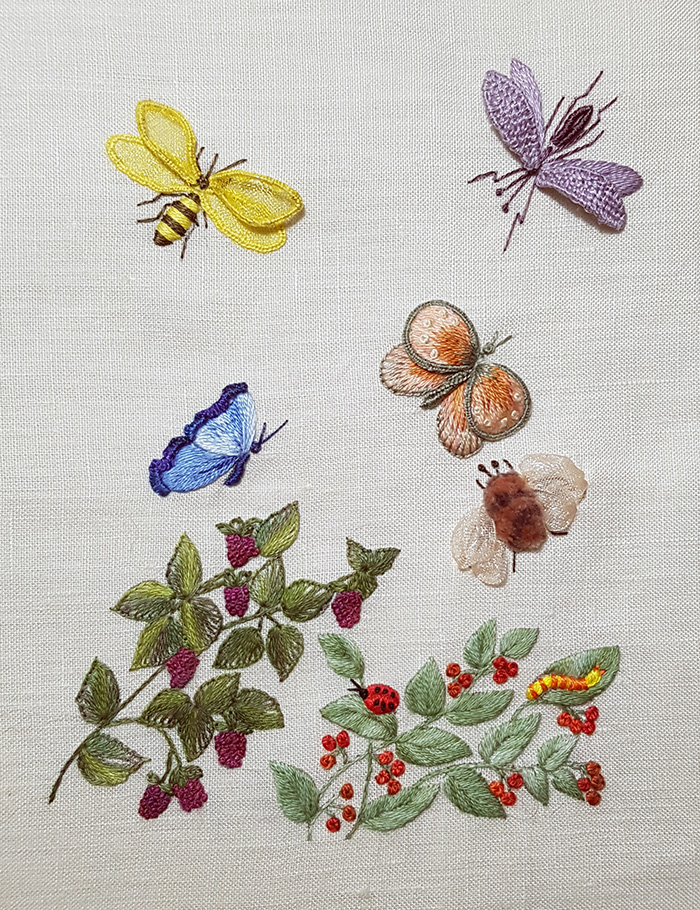
The plants
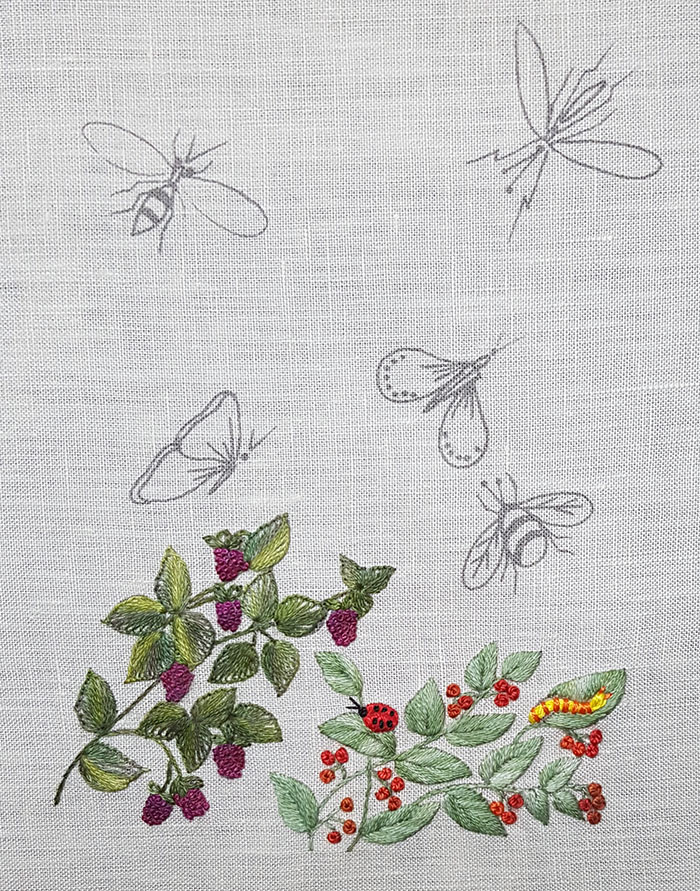
The pattern of this project can be downloaded HERE
Raspberries
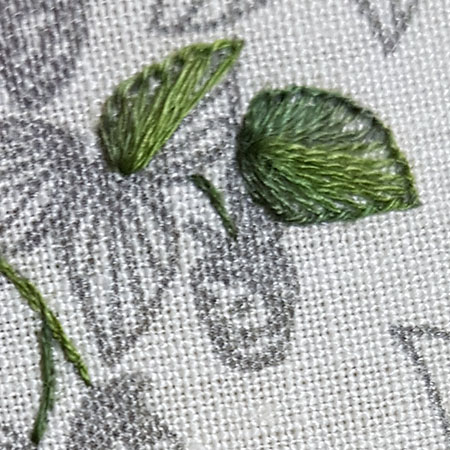
The stems are embroidered in stem stitch with 1 thread.
The leaves are embroidered in blanket stitch with 2 threads. All the stitches start from the base of the leaf and are embroidered fan-shaped. To obtain pretty sharp leaves, I fix the stitch to the top and I continue to embroider on the other side of the leaf.
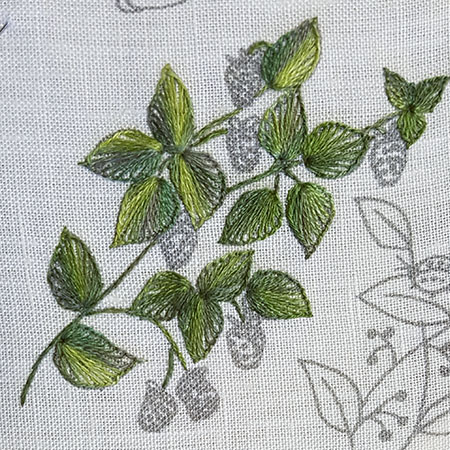
Here is the picture of the completed leaves.
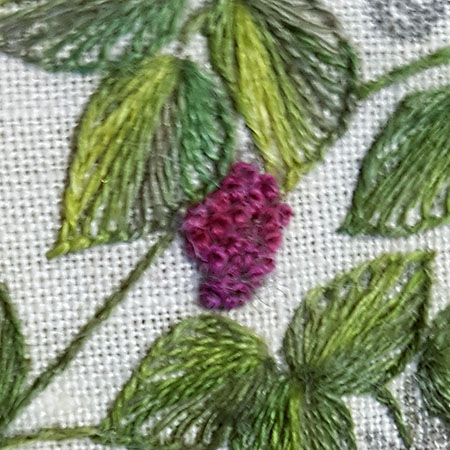
The raspberries are embroidered in French knot with 2 threads and 2 wraps.
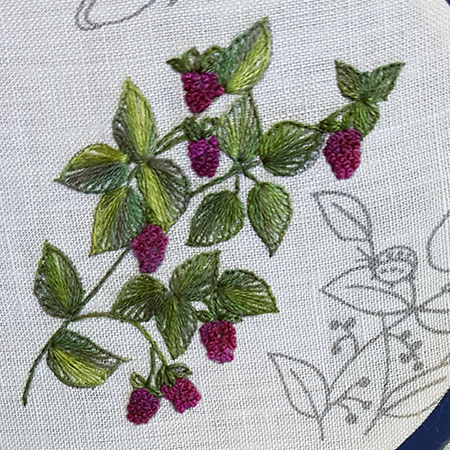
All the embroidered raspberries are complete.
Red currants
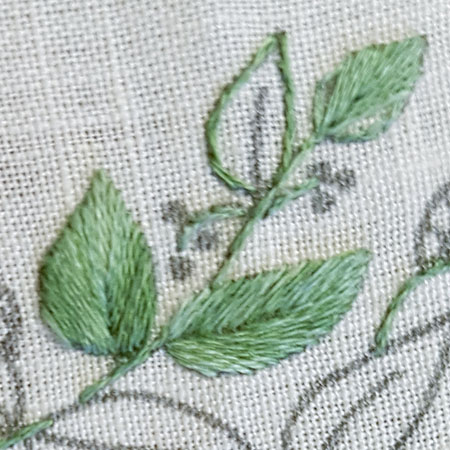
The stems are embroidered in stem stitch with 1 thread.
The leaves are first rimed with split back stitch 1 thread then embroidered in fishbone stitch also with 1 thread.
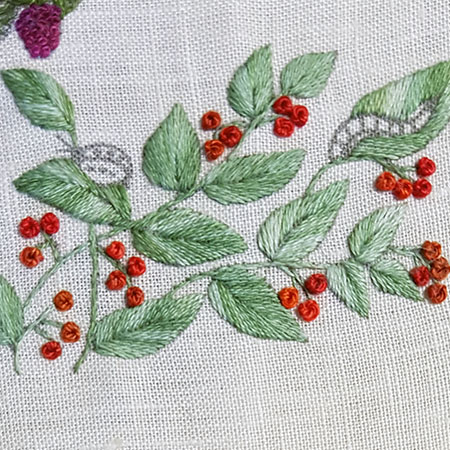
The currants are embroidered in French knot with Perle cotton n ° 8 and 2 wraps.
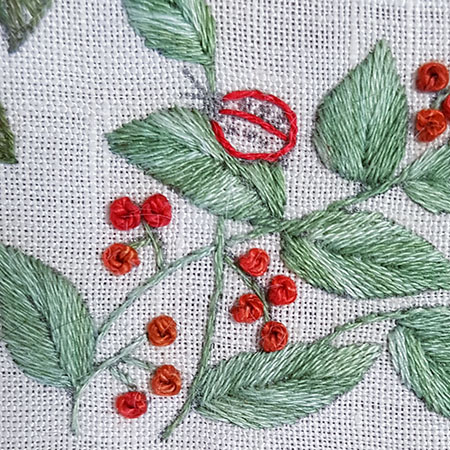
First, embroider the outline of the Ladybug with split back stitch and 1 thread.
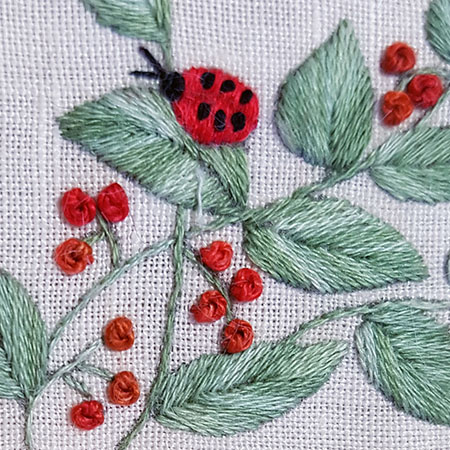
Embroider the Ladybug with satin stitch 1 thread vertically carefully separating the 2 wings.
Embroider the dots on the wings with French knots 2 threads and 1 wrap, the head with a French knot 2 threads 2 wraps and antennas with 2 small straight stitches 1 thread.
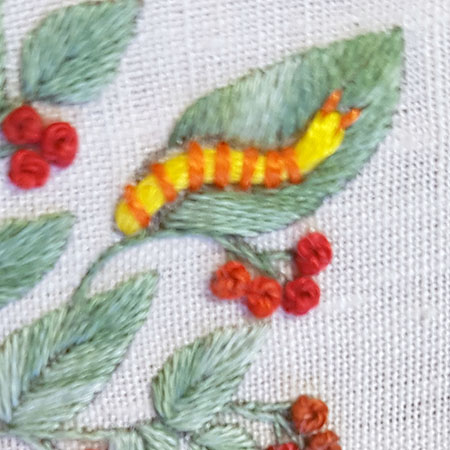
The caterpillar is embroidered in couching with 12 threads for the body and 3 threads for the rings.
The antennas are embroidered in straight stitch with 1 thread.
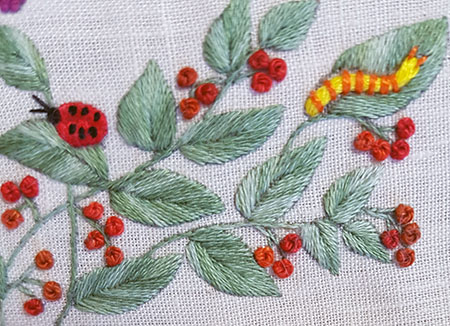
Here is the finished pattern.
The blue Vase part 3
The finished blue vase and the second flowerThis chapter, like the previous one, is devoted to completing the "Blue Vase" embroidery and creating the second flower. The first part contains 2 photos showing the sides of the vase. In the second section, you'll find all...
The blue Vase part 2
The blue Vase and the first flower This chapter is devoted to the continuation of the "Blue Vase" project, and is divided into 2 parts. In the first are simply 2 new photos describing further work in the vase itself. In the second section, you'll find all the...
The blue vase
The blue vase This is the first chapter devoted to this exceptional project. I was drawn to this subject because of the interesting contrast between the vase with its plain flowers and the lightness of the flowers with their sophisticatedly-toned petals. I offer this...
Embroidered Pashmina new design
Embroidered Pashmina new designIn the series of designs for embroidered Pashminas started last year, here's a newcomer. It is made exclusively with 6 threads graded in the same tonal range. It could therefore be described as "quasi-monochrome", as it uses mainly...
Needle painted Dahlia part 5
Needle painted Dahlia part 5 Here are the photos and explanations needed to complete this dahlia. As in previous articles, to make the work easier, I've favored numbering the petals with large photos to distinguish easily the color placement. These are listed below...
A festive Sunday
A festive Sunday I'd imagined offering it to you for Mother's Day, but here it is, finished and ready to brighten your weekend. With its dapper colors and touching naivety, this little project is really easy to complete in a few hours. It does not require any special...
Needle painted Dahlia, part 4 the center
Needle painted Dahlia part 4, the center Here are the colors used to embroider the center of the dahlia and the little petals around it. To make the work easier, I've favored numbering the petals with large photos to best distinguish color placement. These are...
Needle painted Dahlia part 3
Needle painted Dahlia part 3 Here's a whole series of new petals on the left-hand side of the dahlia, embroidered in shades of red, orange and yellow. To make the work easier, I've opted for petal numbering with large photos to distinguish color placement...
An Easter egg in the colors of time
An Easter egg in the colors of time Here's the 2024 version of my traditional embroidered Easter egg. I've chosen it full of freshness and sweetness. I hope it will accompany you in your celebration of this holiday, which this year, although dependent on an...
Mixed techniques part 2
Mixed tchniques Battlement Couching Battlement Couching is an embroidery technique with ancient roots, probably originating in the Middle East or Asia. It has been used for centuries in various cultures, particularly in regions where intricate textile arts...