Provence
The Trees
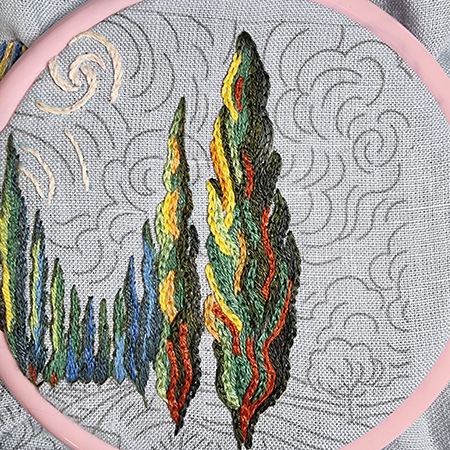
In this second stage of the Provence project, our gaze naturally turns to trees, and quite naturally to cypresses, the iconic silhouettes of the Mediterranean landscape.
Their presence structures the scene, in rhythm and verticality, and creates an atmosphere that is both peaceful and solemn, almost timeless.

These trees are not just decorative elements: they organize the space and guide the eye. I chose to place them on two distinct planes in order to enhance the depth of the landscape.
In the background, smaller cypress trees line the path that gradually recedes into the scene. Their shapes are simpler, their colors relatively uniform, as if slightly blurred in the distance.
In the foreground, however, the tall cypress trees stand out more prominently. Their sinuous lines are more clearly defined, their volumes more assertive, and their colors more contrasting, bathed in light. Exposed to the sun’s rays, they capture the variations of green, blue, and yellow, becoming the true pillars of the landscape.
It is this repeated, rhythmic verticality that gives the setting its expressive power. It imbues the whole with a certain solemnity and contributes to the overall balance of the composition.
Here are the colors I used to make these trees.

DMC 307

DMC 703

DMC 824

DMC 825

DMC 924

DMC 400
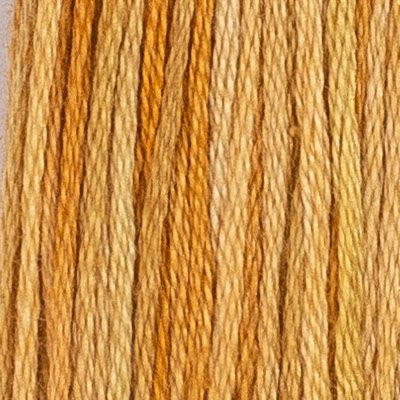
House of Embroidery 26C Gold

House of Embroidery 53C Mexico
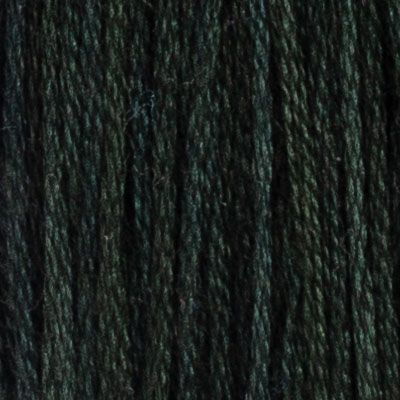
House of Embroidery 269A Woodland
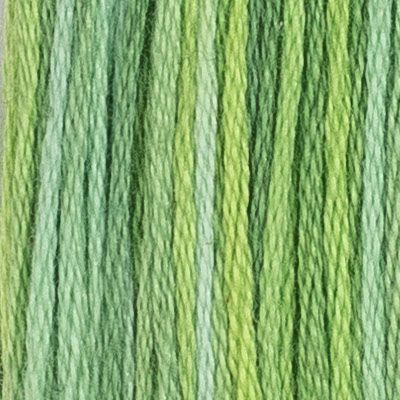
House of Embroidery 67C Apple
To guide you in making them, here are some close-up photos.
Trees located on the left side of the landscape.
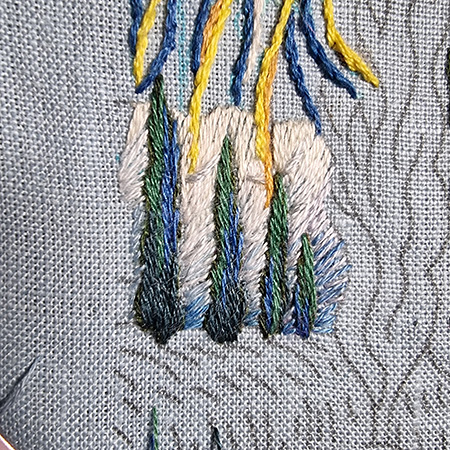
These are the small trees on the far left of the design. They are embroidered using the darkest colors (green and blue) from the selection, with long and short stitch using 1 thread. To give these small motifs some relief, they must first be outlined using split backstitch with 1 thread. The background behind the trees is part of the sky and will be explained later.
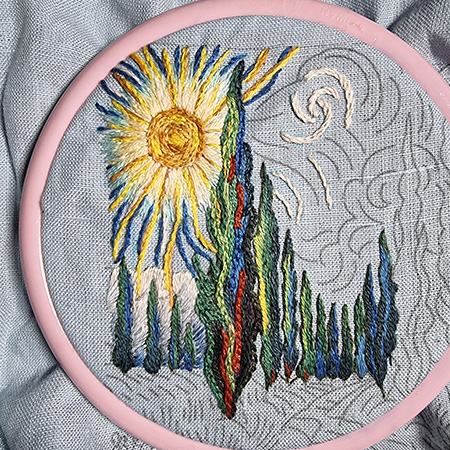
Now fill in the small empty areas iwith long and short stitch by varying the colors, but favoring the use of darker tones on the right side of the tree.
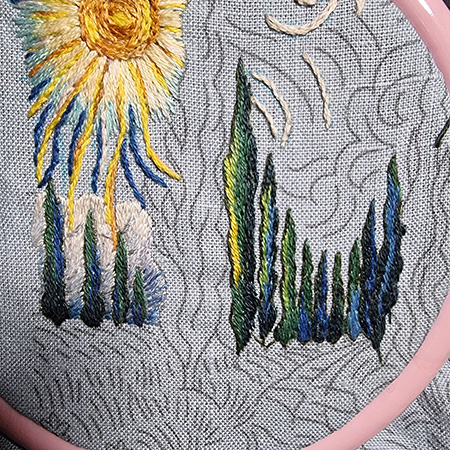
This photo shows the beginning of the work on the trees located in the central part of the design. The smaller trees are embroidered in the same way as those on the left. Add a few stitches with yellow thread to represent the sun shining on the side of the trees.
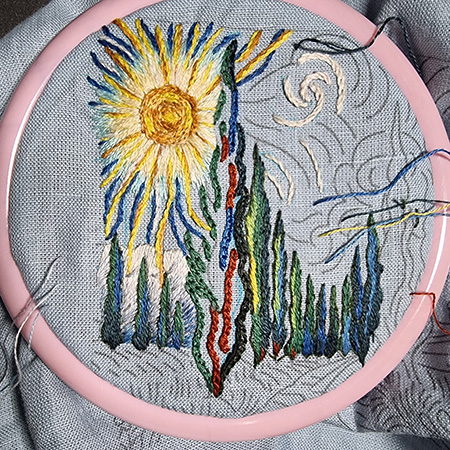
To create the largest tree located slightly in front, start by embroidering winding lines using chain stitch with 2 threads in the same colors as before, but adding color 400 to represent a few branches in the middle of the foliage.
Trees located on the right side of the landscape.
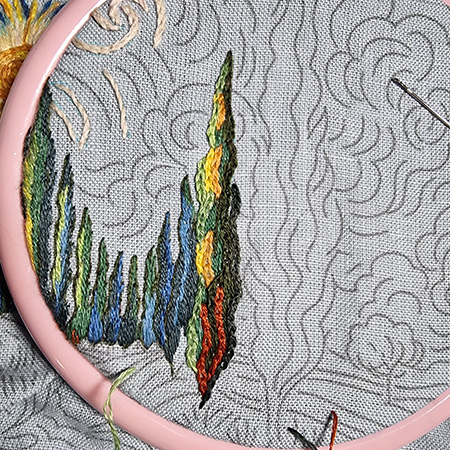
This photo shows the smallest cypress tree on the right side of the drawing. It is embroidered in exactly the same way as the larger tree on the left, the creation of which is explained above.
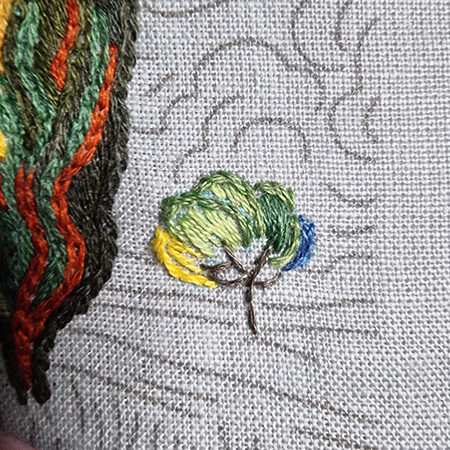
This small tree sketched in the distance is created by embroidering its outline using stem stitch with two threads, then filling it in using straight stitch with one thread. The trunk is created using stem stitch with one thread, using a strand of gray-brown thread.
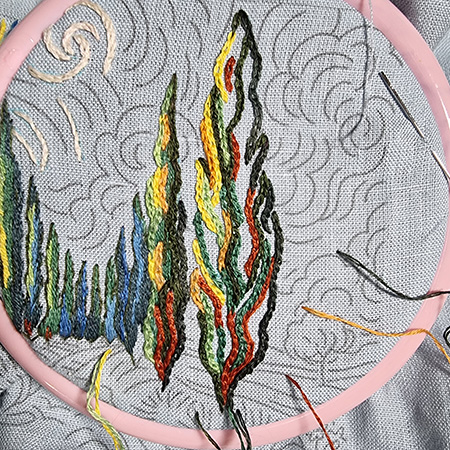
For the largest cypress tree, working in the same way, here is the placement of the lines to be made using chain stitch with 2 threads.
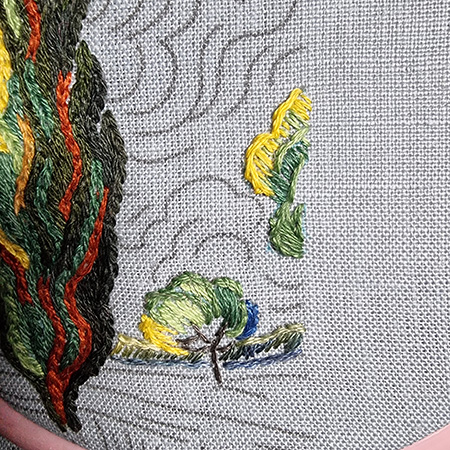
Proceed in the same way to embroider the partial section of the tree shown on the far right. The section of the fields that has already been completed will be explained later.