Select Page

Wildflowers

The first flowers are blooming

Now that we have laid the groundwork for this embroidery, it’s time to dive into the heart of the project and bring the first flowers to life.

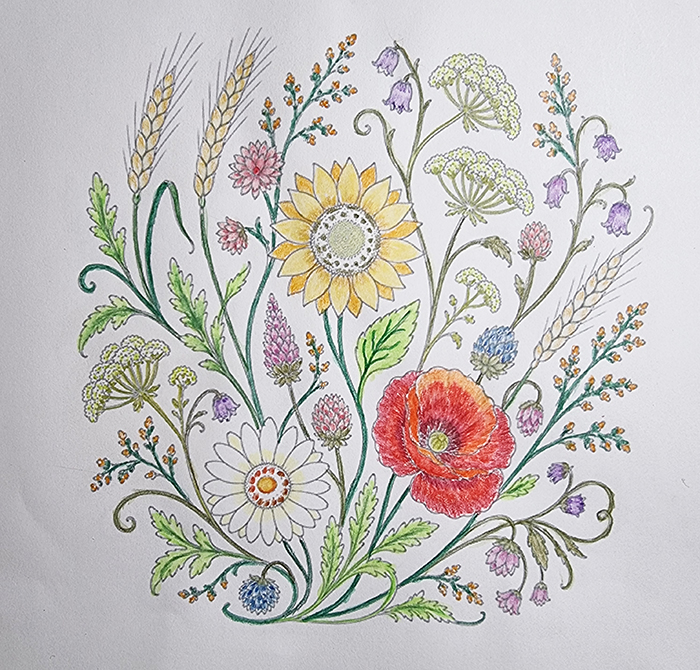
For this second step, I chose to embroider two of the summer meadow’s stars: a radiant daisy and a vibrant poppy. Surrounding them, a few leaves already hint at the movement that will run through the entire composition. As always, the work relies on simple stitches, but these are enhanced by the choice of colors and the delicate layering of shades, which lend depth and spontaneity to the whole.

The Poppy


A true symbol of summer fields, the poppy instantly adds a splash of vibrant color to the embroidery. Its petals were created using the blanket stitch, combining several shades of red to suggest the delicate folds and translucence that characterize this delicate flower. A few deeper shades accentuate the depth of the center and lend greater volume to the corolla.

DMC 606, 666, 817, 350, 347, 221

House of Embroidery Lemon & Lime 25A

The petals are embroidered using blanket stitch, long and short stitch and satin stitch with a single strand of thread. For the right petal, I used colors 350, 666, and 347. For the two petals at the bottom of the flower, I used colors 350, 666, and 221.

This large petal is embroidered in the same way as the previous ones, but using colors 606, 817, 347, and 221.

The lower part of the central petal is embroidered using the satin stitch with 1 strand of thread in color 817.

The backs of the central petals are also embroidered using the satin stitch, but with colors 606 and 666. The center of the flower is created using an whipped spider web stitch and two-wrap French knots s all worked with two strands of thread in color 25A.

The daisy


To balance the boldness of the poppy, the daisy brings all the softness and freshness of meadow flowers. Its white petals are embroidered using the long and short stitch technique with slight variations in tone, preventing any sense of monotony. The center, worked with different stitches and several shades of yellow, ochre, and brown, creates a warm contrast that naturally draws the eye to the heart of the flower.

The leaves accompanying these two flowers play a key role in balancing the composition. Made with a gradient green thread, they introduce the movement that will bring the entire design to life. Their slightly jagged edges set the stage for the many flowers that will soon enrich this cheerful meadow. 

DMC white, 746

 House of Embroidery Marigold 90C

House of Embroidery Gold 26A

House of Embroidery Apple 67A

To embroider the daisy, I used a 1-thread long and short stitch and the color White for the main petals. The small petals at the back and the bottom of the main petals are done in color 746. I embroidered the outer edge of the flower’s center with an overcast chain stitch  in a circle using two threads for the chain and one thread for the overcast, in colors 90C and 26A. The center of the flower is made up of two-thread, two-wraps French knots in color 26A.

The leaves are embroidered using the fishbone stitch with 1 strand of thread in color 67A. Add a central vein to each leaf using the backstitch with 1 strand of thread in DMC color 703. Before filling them in, you must outline their contours using the split backstitch with 1 strand of thread to ensure precise embroidery.

This large leaf is made using the overlapping stitch with 1 thread and color 67A. It is then embellished with a vein using the seed stitch, made with 2 threads and color 703.

Little by little, the meadow comes to life and reveals its character. Next week, we’ll let the clover blossoms and wheat ears bloom. Their subtle yet essential presence will help create the summery atmosphere that inspires the entire composition.