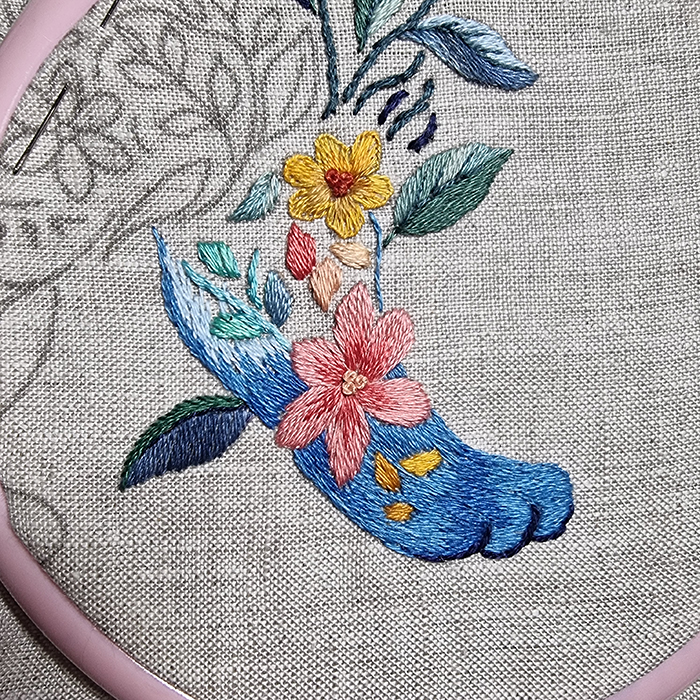
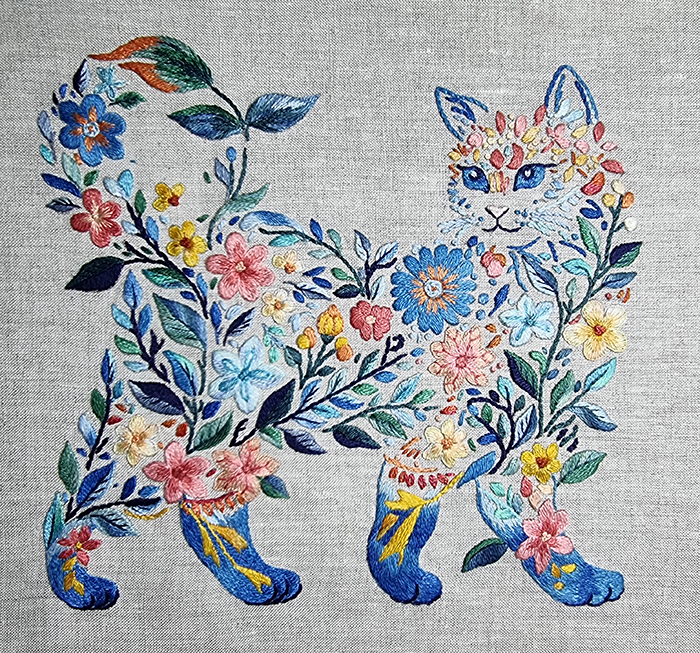
A Garden for Pam & Lola
The body takes shape
After bringing this little cat’s expressive eyes to life, we’re now moving a few centimeters down, to that delicate transition zone where the head meets the front paw.
Here, the patterns unfold with greater freedom.
I chose to work on this section first by adding small strokes near the face, then gradually embroidering more prominent flowers and more detailed foliage, until the line of movement naturally leads toward the paw.
Color plays a key role here. It accompanies this transition by shifting from the softest hues to slightly bolder contrasts, without ever disrupting the overall harmony.
This first photo is centered around four flowers with very distinct characteristics, each contributing its own unique quality to the overall composition. Before going into detail about them, a few words about the foliage that gives structure to the entire composition.
Serving as the true framework of the design, it is worked with a light touch to complement the flowers without ever weighing them down. The main stems are embroidered in stem stitch using two threads, while the thinner ones are done with a single thread. The large leaves are executed in two parts using the satin stitch, playing on subtle color variations. Fine veins, embroidered in straight stitch with a single thread, then enliven the surface: they are generally made using the shade used in the darkest part of the leaf, thus creating a subtle contrast. The smaller leaves, meanwhile, are embroidered in fishbonestitch using a single color.
It would be difficult to list every possible color combination here, as there are so many. Feel free to mix and match different shades of blue and green to create rich, nuanced variations that will bring the foliage to life. You can, of course, draw inspiration from the combinations shown in the photos.
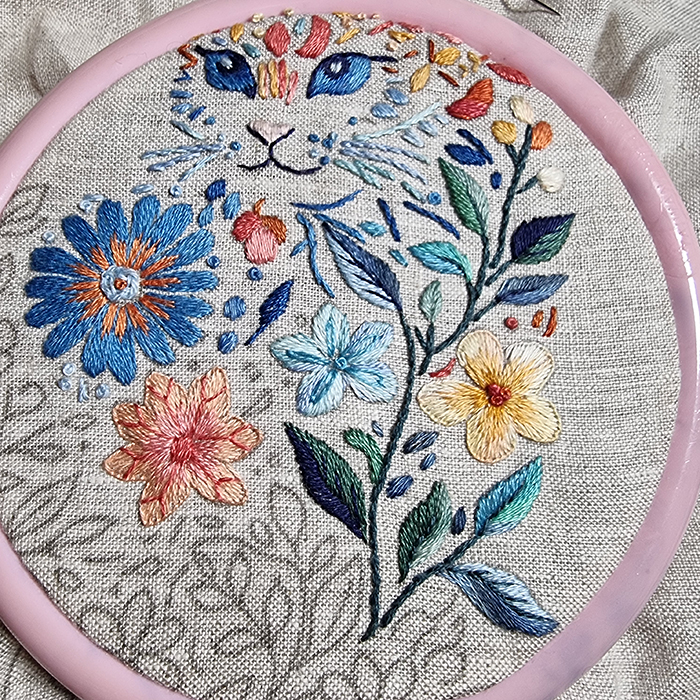
The large blue flower on the left is embroidered using the long and short stitch with thread color 73C. To highlight its structure, the base of each petal is accented with single-thread straight stitches in shade 922. Its center is formed of a chain stitch worked in the round with two threads (827) and finished with a two-wrap French knot in color 922.
The pink flower, located just below the large blue flower, adds a softer touch by introducing a very interesting interplay of textures. Its petals are embroidered in blanket stitch using thread in color 3771. At the base of each petal, straight stitches in thread color 760 radiate toward the center. To accentuate the motif’s depth, each petal is outlined with a large fly stitch, made with thread in color 3328, and the center of the flower is embroidered in satin stitch with thread in the same shade.
To the right of the pink flower is a smaller flower. Its petals are embroidered using the satin stitch with thread in color 4020. Each petal is then accented with a large lazy daisy stitch, worked with two strands of thread in color 807. The center consists of a single French knot, made with two strands of thread and two wraps in the same shade, 807.
Finally, on the far right, a yellow flower brightens up the design and adds a touch of vibrancy to the whole piece. Its petals are embroidered using a blanket stitch in color 4090. They are then accented with straight stitches made using thread in color 26C. The center is simply marked by three French knots, worked with two strands of thread and one wrap in color 919.
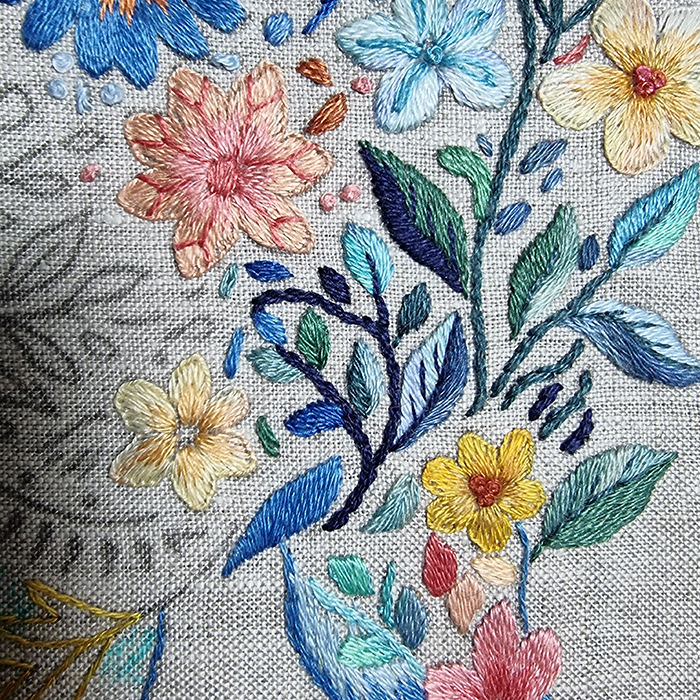
This second photo takes us down to the lower part of the cat’s body, where it meets the right front paw.
Some of the flowers described earlier are included here, along with two new ones. Both are embroidered using the same technique as the yellow flower in the previous photo. One uses exactly the same shades, while the other features a more intense variation, with petals in color 3820 and a center embroidered in shade 919. The photo also allows for a closer look at a group of leaves, shown here in close-up. This detail highlights the foliage work and how it structures and complements the overall design.