Mixed techniques
The last 4 leaves
Here are the explanations needed to complete the remaining leaves in this project, which began in February.
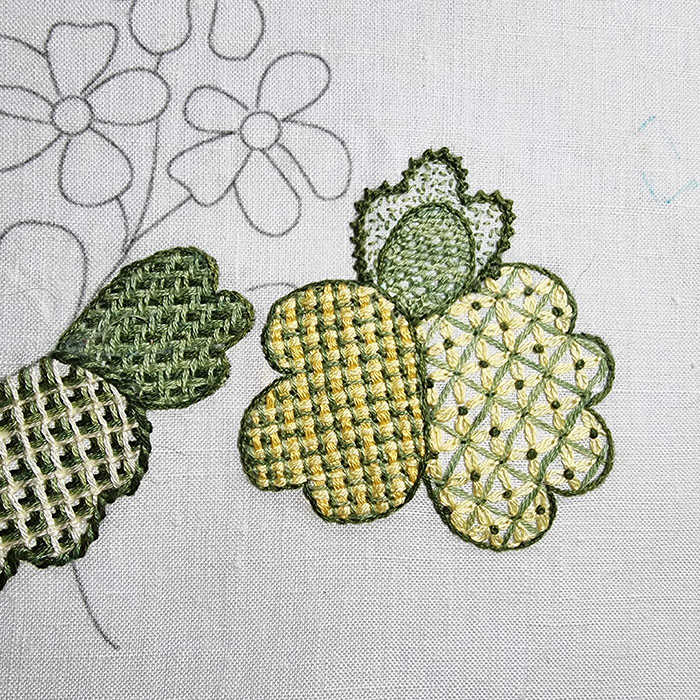
The right leaf in the left group
Simple weaving technique with 2 colors
The warp forms the longitudinal structure of the weave, while the weft threads are interlaced perpendicular to those of the warp to create the fabric’s pattern and texture.
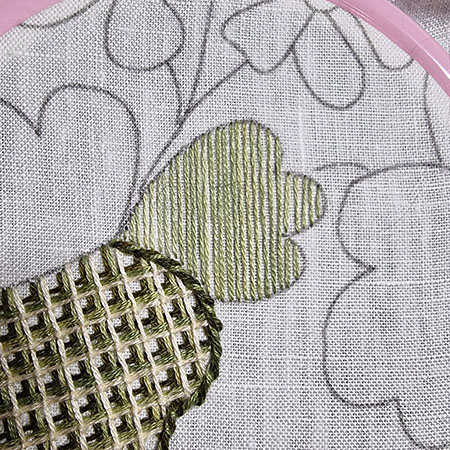
Start by forming the chain with 2 threads evenly over the entire surface of the pattern.
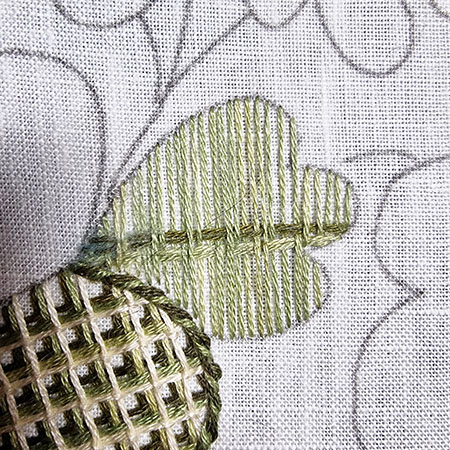
The pattern is created as follows
Weave back and forth (2 rows) on 2 threads and under 2 warp threads with 2 strands of cotton, using the first color. Do the same with the second color, but shift the weave by one thread, to the right or left, depending on your choice. It’s easier to start in the middle of the pattern.
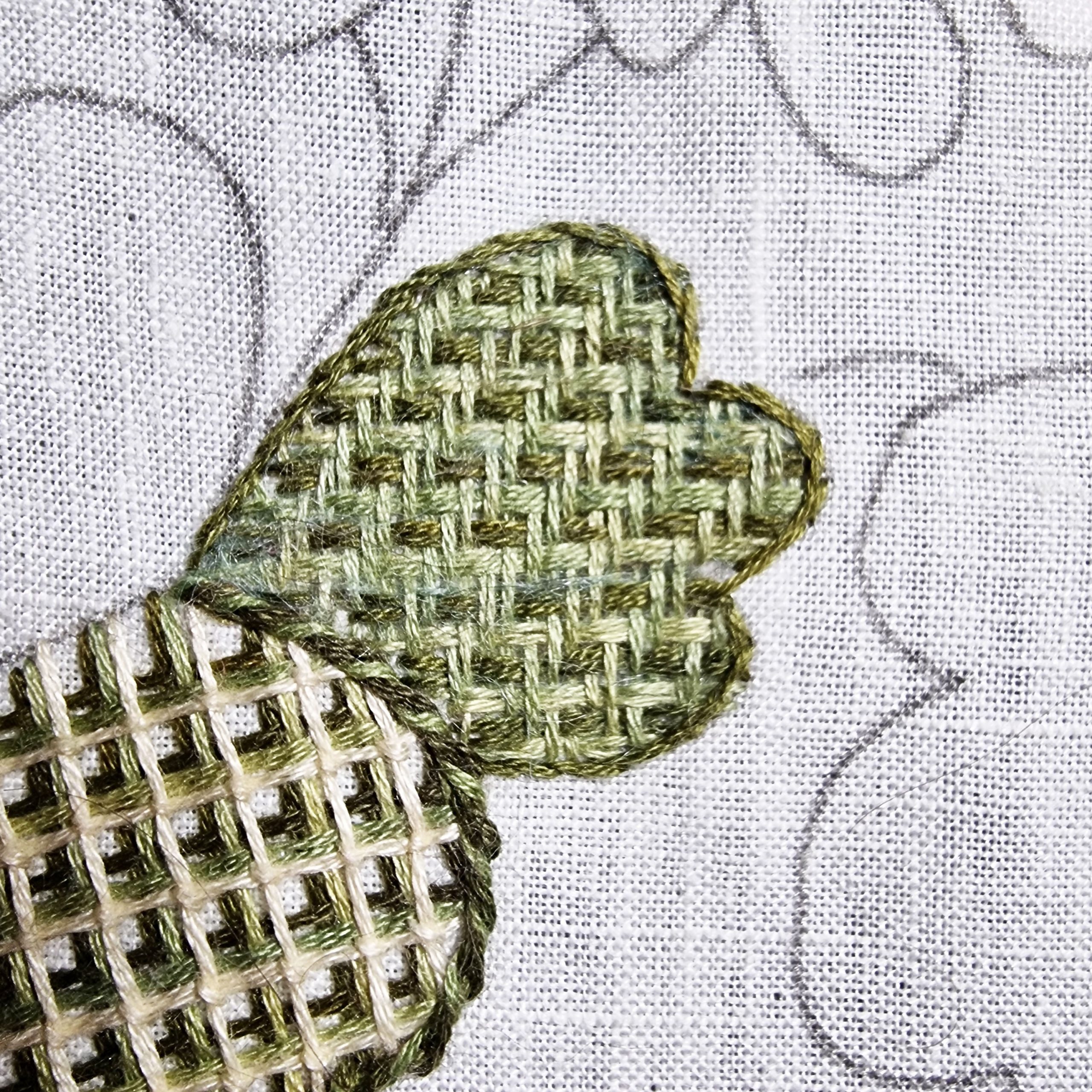
Repeat these 4 rows until the motif is completely filled, ending with a 2-thread stem stitch around the leaf.
The right leaf in the right group
Trellis weaving and filling with lazy daisy stitch and French knots.
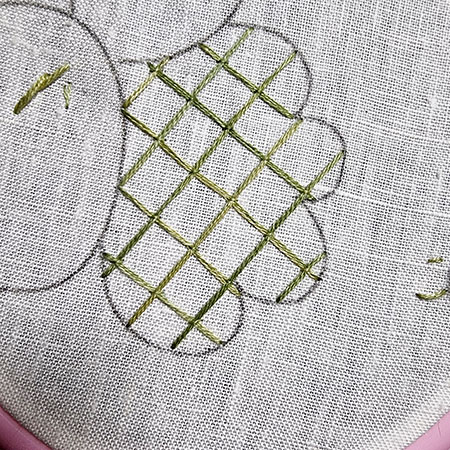
Place long stitches (with 3 threads) in trellis spaced far enough apart and hold them in place with a small straight stitch 2 threads at each crossing.
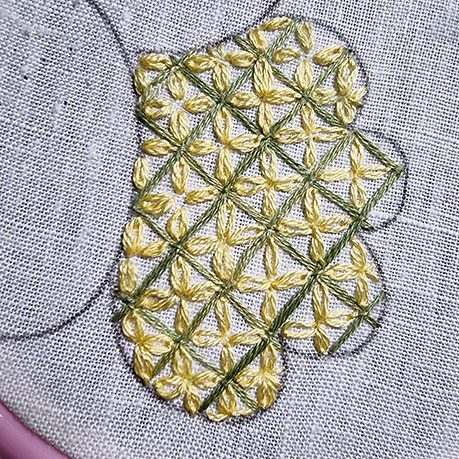
Place 4 cross lazy daisy stitches made with 2 threads in each square formed by the trellis.
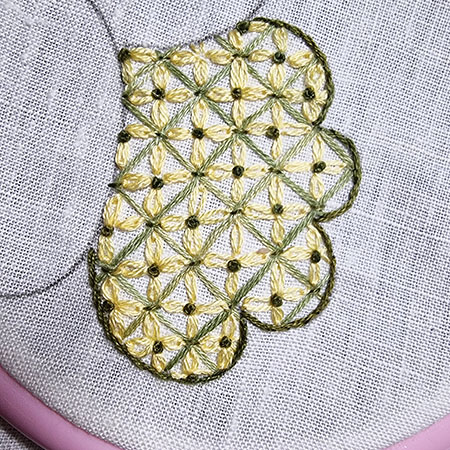
Embroider a 2-thread, 2-wrap French knot in the center of each group of lazy daisy stitches and finish with a 2-thread stem stitch around the motif.
The left leaf in the right group
Lattice weave with 4 colors
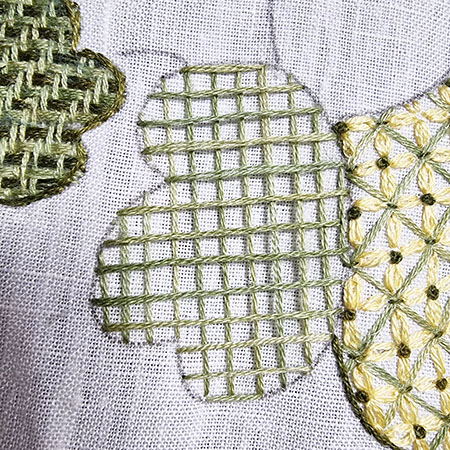
Prepare a cross lattice spaced approx. 3mm apart with 3 threads and the first color.
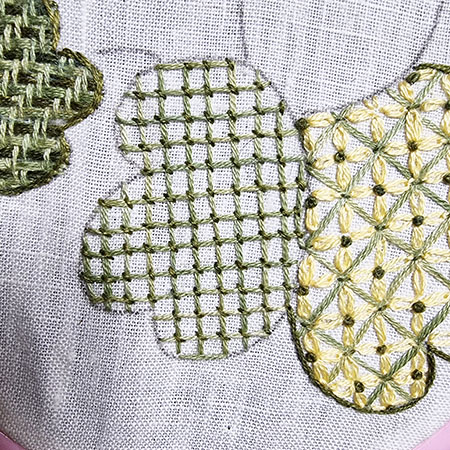
Attach this grid to each cross-brace with a small straight stitch in the second color and 2 threads. Preferably work diagonally.
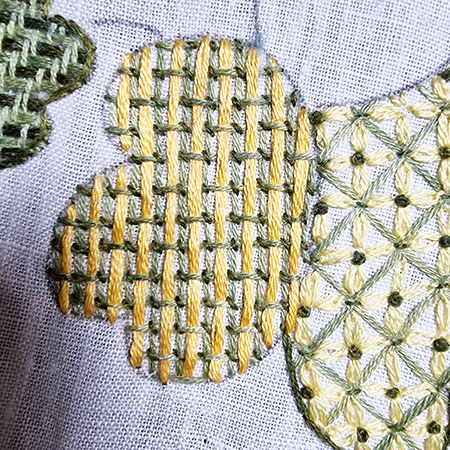
Make a first weave with the third color between the top-bottom lattice threads in one direction only. Use the whole strand (6 threads) and try to lay them flat to occupy the free space.
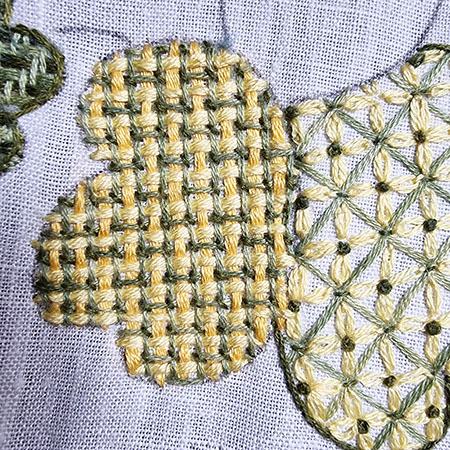
Lay a new layer of weave with the fourth color perpendicular to the first, but passing under a trellis thread and over the thread of the previous weave. Also, use the 6 threads of the strand and lay it flat.
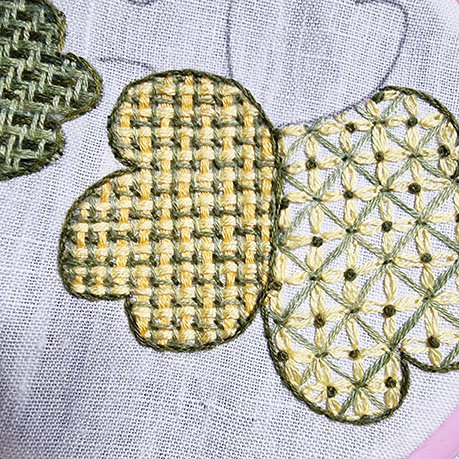
Finish with a stem stitch with 2 threads all around the leaf.
The top leaf in the right group
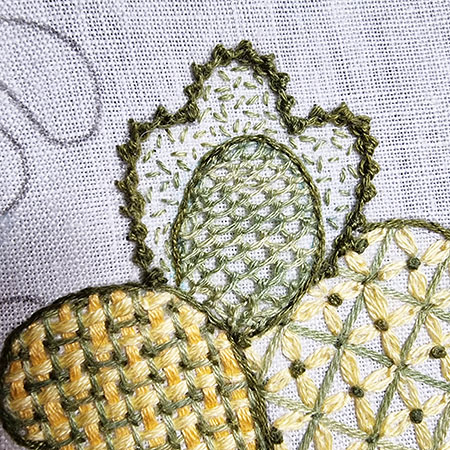
simple needle lace
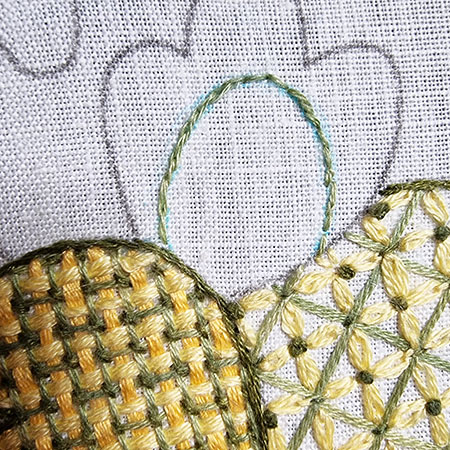
First, mark the center of the leaf with a 2-thread split backstitch.
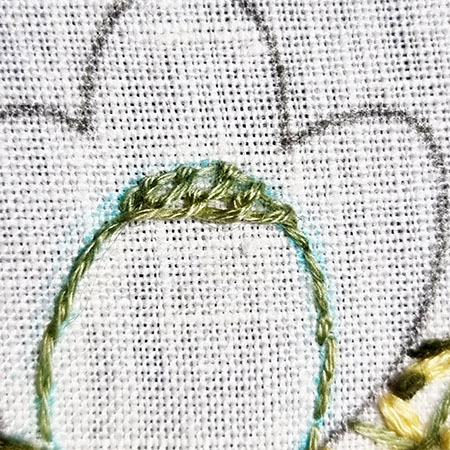
Start the needle lace at the top of the motif. Embroider a row of fairly widely spaced 2-thread blanket stitches hooked into the border, but without stitching into the fabric. For a right-handed person, this row starts on the left outside the backstitch and ends on the right, also outside the backstitch. Then return with the thread, passing under the work and coming out just below the starting point of the first row (left). Stitch a new row of blanket stitches in the “stitches” of the previous row, still without stitching into the fabric. Work in this way to cover the entire surface of the motif. For ease of use, we recommend using a round-ended needle.