


Tissue Box
Tile 1
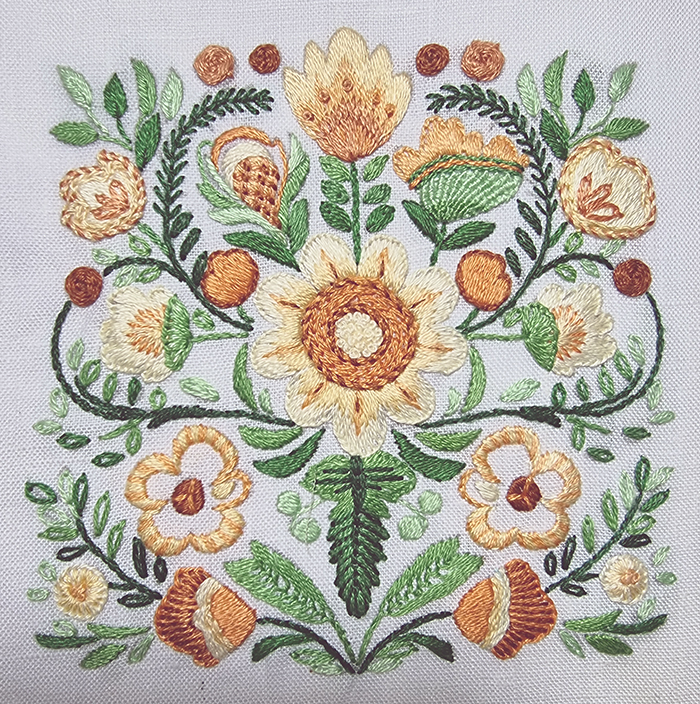
This new tissue box project combines the useful with the pleasurable: a simple object to integrate into the home, but worked in detail to make it a refined piece.
I’ve designed four small, complementary motifs that will work equally well on this object and on other surfaces. You can use them as they are, together or separately, according to your needs.
All summer long, in several articles, I’ll be guiding you through the step-by-step creation of this model, with all the advice you need to make the most of it.
The pattern, accompanied by a numbered version to make it easier to follow the explanations, is available for download HERE.
The box and the colors
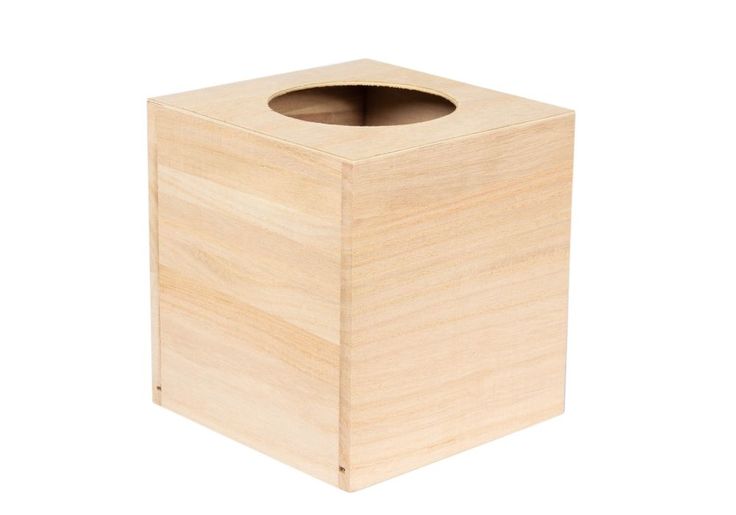
The support used is a simple wooden box, found in a craft supplies store. Each side measures approximately 12.5/12.5 cm, which seems to be a standard format for this type of object. This kind of box is easy to obtain and generally very affordable, whatever the country.
For the choice of colors, I opted for a precise organization: the five selected shades of green will form the basis of the project. They will be used on all sides of the box, for all the foliage. On the other hand, each floral motif will be treated in a different harmony, to bring variety and highlight each composition.
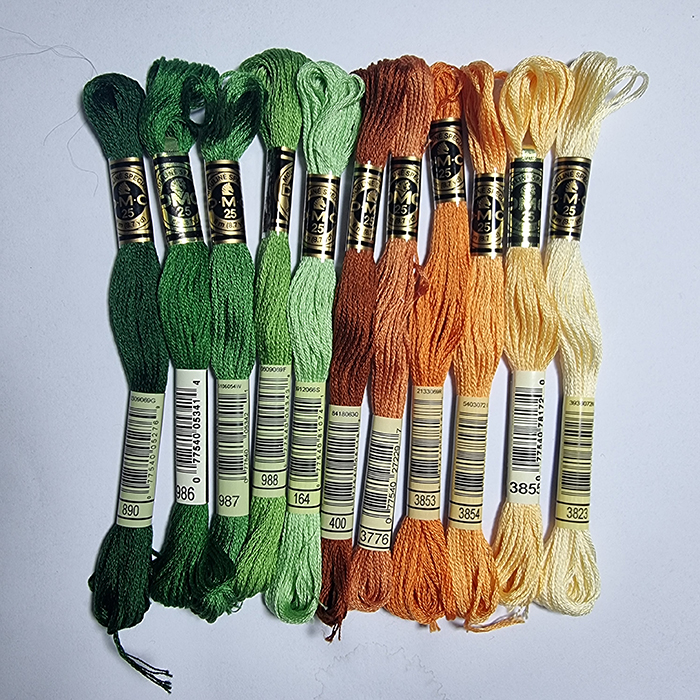
The shades of green chosen to embroider the foliage are:
DMC 890, 986, 987, 988 and 164.
The shades of yellow and orange chosen to create the flowers on this first face are:
DMC 3823, 3855, 3854, 3853, 3776 and 400.
Design instructions
Flower n°1
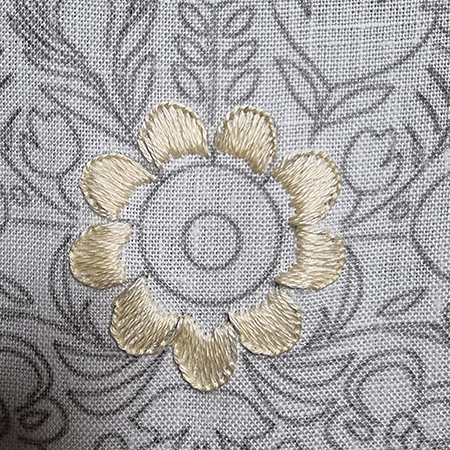
First, embroider the upper part of the petals in blanket stitch with 2 threads.
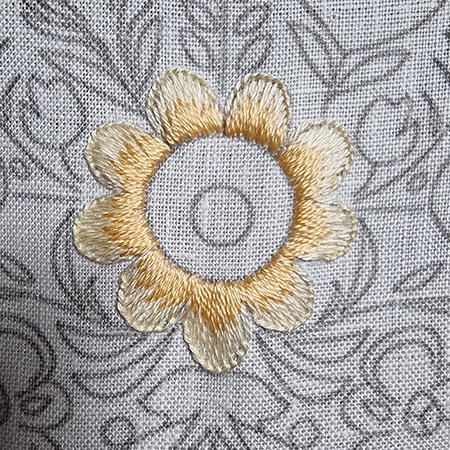
Finish filling each petal with straight stitches of another color using 2 threads.
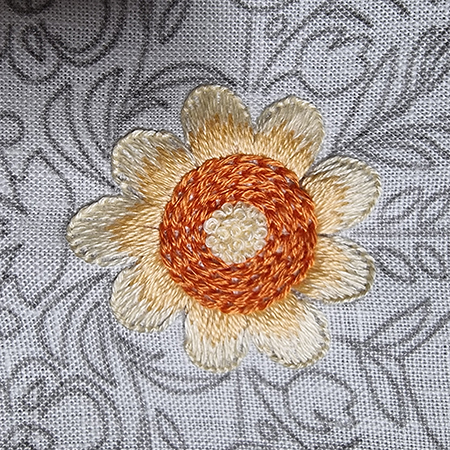
Fill the outer part of the center in round chain stitch with 2 threads and the remaining part with French knots 2 wraps and 2 threads.
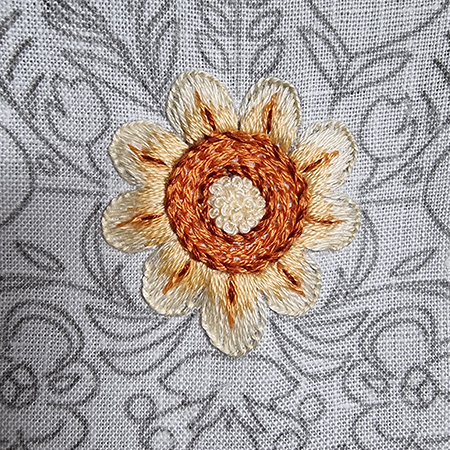
Oversew the outer and inner rows of chain stitches with a contrasting color and 2 threads. In each petal, embroider an elongated lazy daisy stitch with 2 threads and place a straight stitch in a contrasting color with 2 threads on the inside.
Flower n°2
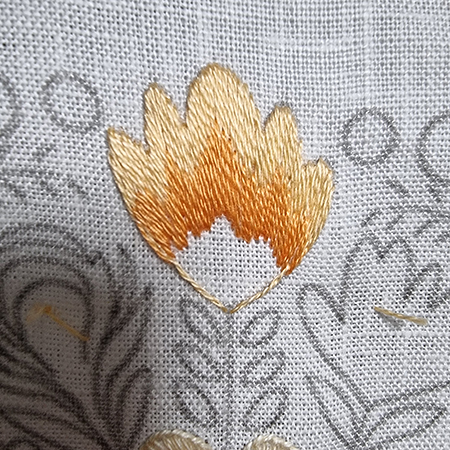
Embroider the upper part of the flower in long and short stitch with 2 different colors and 1 thread.
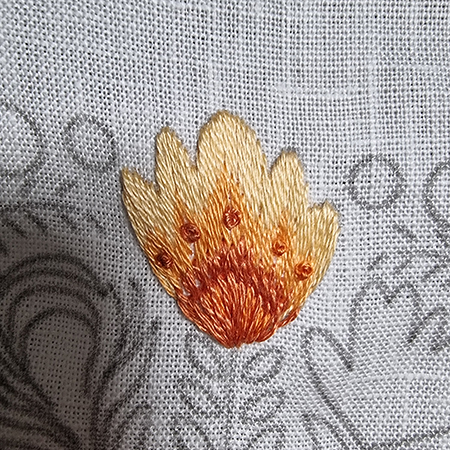
Finish the lower part of the flower with a 2-thread overlapping fly stitch. Decorate the motif with a few 2-thread, 2-wrap French knots.
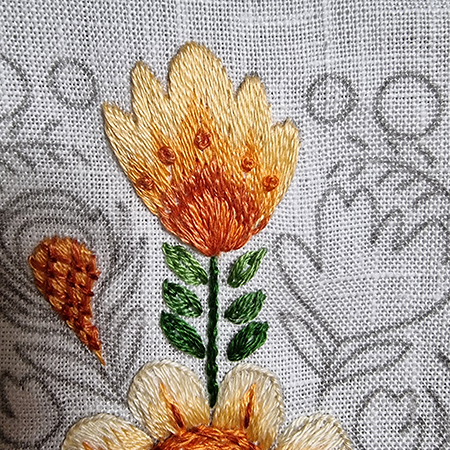
Embroider the stem in stem stitch and the leaves in double lazy daisy stitch, all with 2 threads.
Flower n°3 and 4
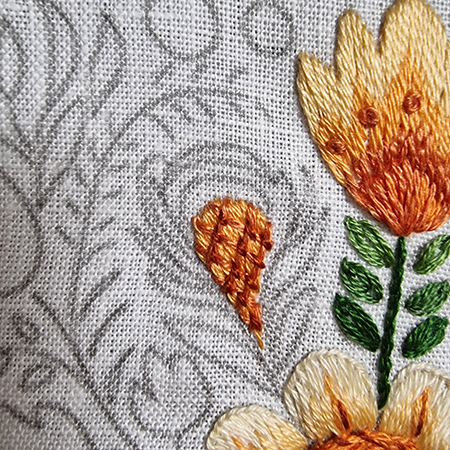
Embroider the center of the flower with long and short stitch 1 thread, covered with a lattice stitch. Use 2 threads for the lattice-stitch grid and 1 thread for the small stitch on each cross-brace.
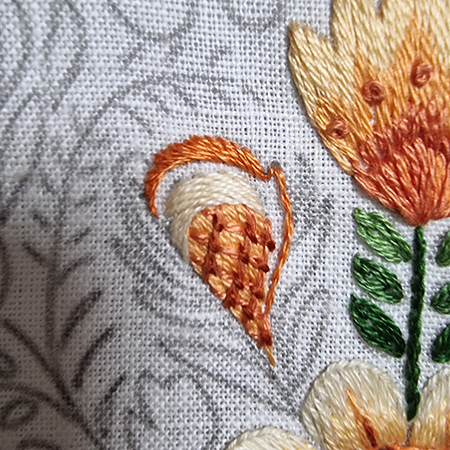
Embroider the 2 parts above the center in satin stitch with 2 threads for the wider part and 1 thread for the narrower part. The right outer edge of the flower is stem-stitched with 2 threads.
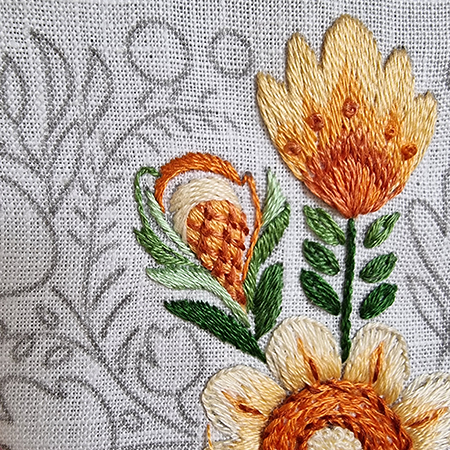
Leaves are embroidered in satin stitch with 1 thread in varying shades of green.
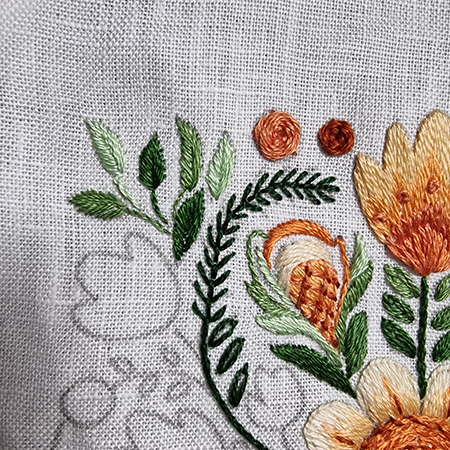
Embroider the large branch in fly stitch with 2 threads and the small leaves in fishbone stitch with 1 thread, all in varying shades of green.
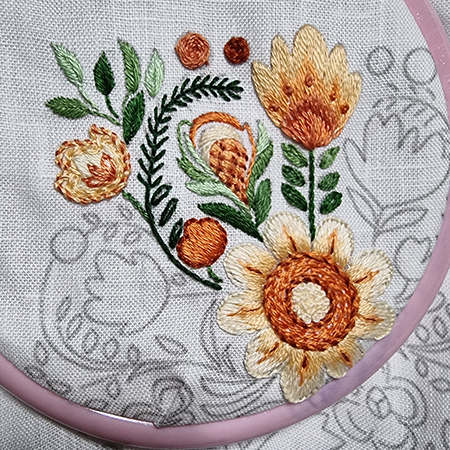
Fill this flower with a plain long and short stitch, then border it with 2 rows of 2-thread chain stitches. Overcast the outer chain with 2 threads of contrasting color and decorate the motif with 3 large 2-thread lazy daisy stitches.
Flower n°5
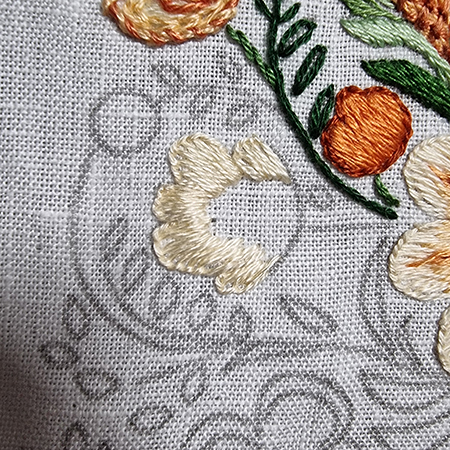
Embroider the upper part of the flower in blanket stitch with 2 threads.
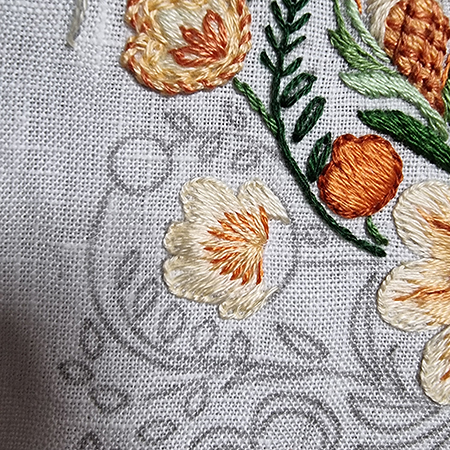
Extend blanket stitches with fan-shaped straight stitches, alternating 2 colors and using 2 threads.
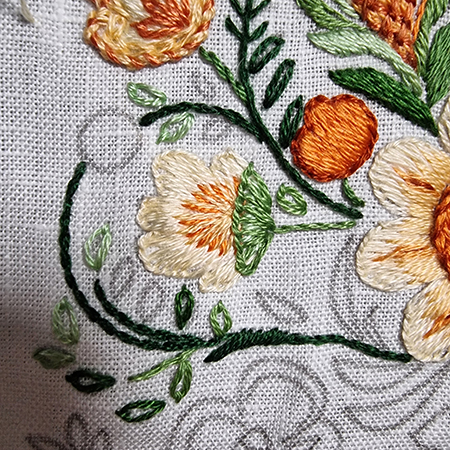
Embroider the flower calyx in blanket stitch with 2 threads. Embroider the large stem in stem stitch and the small leaves in lazy daisy stitch, all with 2 threads.
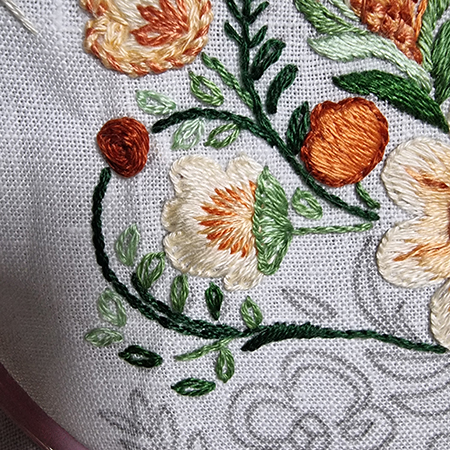
This large decorative dot is made with a single spider web stitch and 2 threads.
Flower n°6
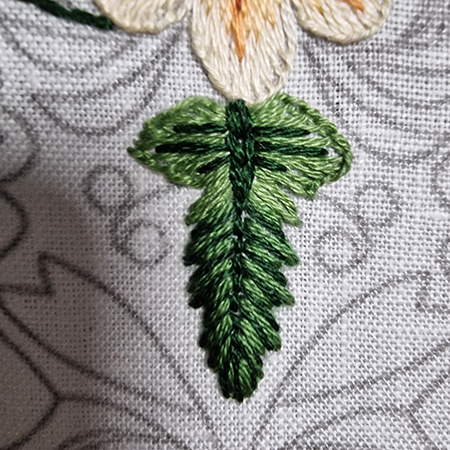
Embroider the plunging central part of the leaf with spaced fly stitch 2 threads, then intersperse straight stitches made with three contrasting-colored threads between the branches. The 2 leaf sides are embroidered in blanket stitch with 2 threads. Embroider a chain stitch to mark the center vein and straight stitches for the side veins, all with 2 threads.
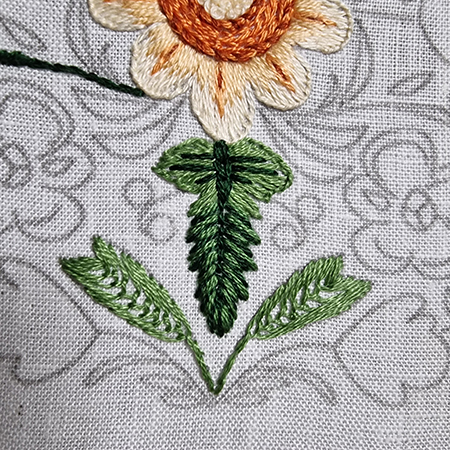
These leaves are embroidered in Cretan stitch with 2 threads.
Flower n°7
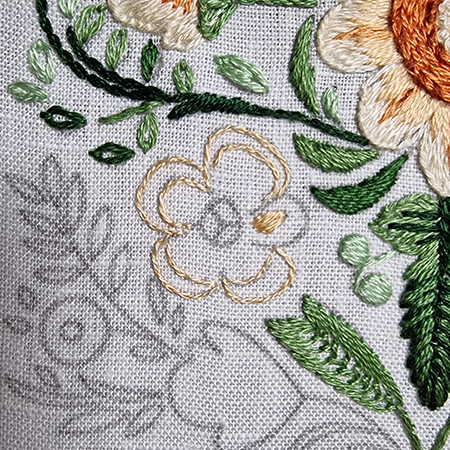
Mark the outline of this flower with 2 rows of 1-thread split backstitches to form a border.
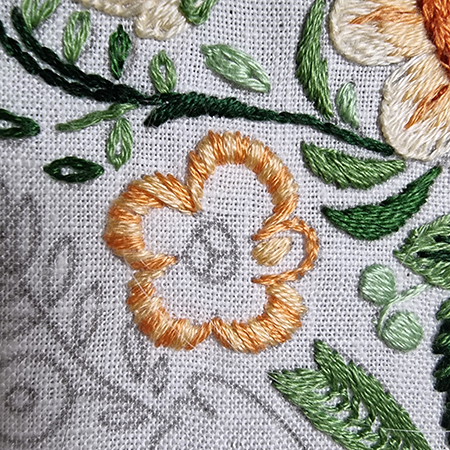
Embroider this border by alternating 2 straight stitches with 2 threads of different colors to obtain a striped effect.
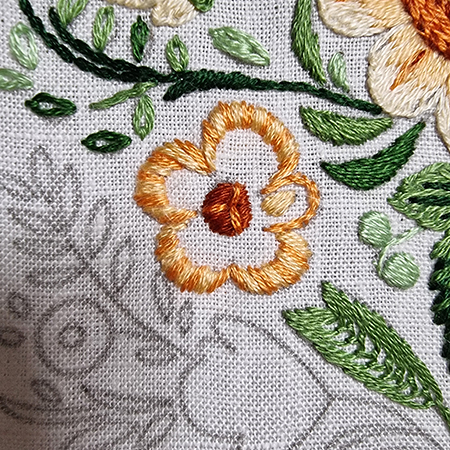
Embroider the center with 1 thread and trim with 3 straight 2-thread stitches.
Flower n°8
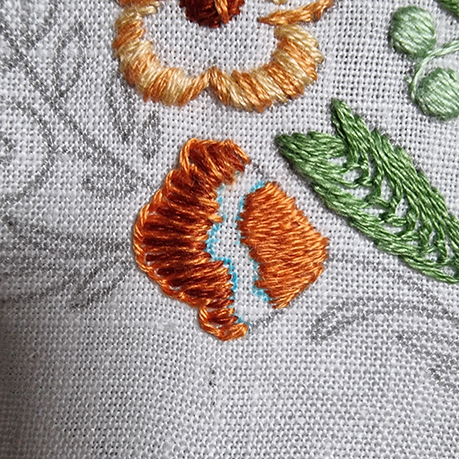
Embroider the upper part of the flower in spaced blanket stitch, interspersing contrasting-colored straight stitches between the branches, using 2 threads. Embroider the lower part of the flower in satin stitch with 1 thread.
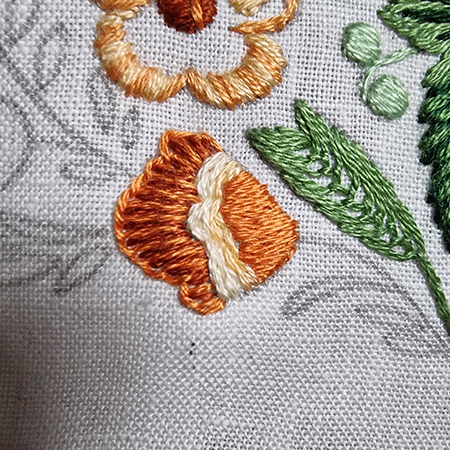
Embroider a two-tone border in stem stitch with 2 threads between the 2 already filled parts of the flower.
Flower n°9
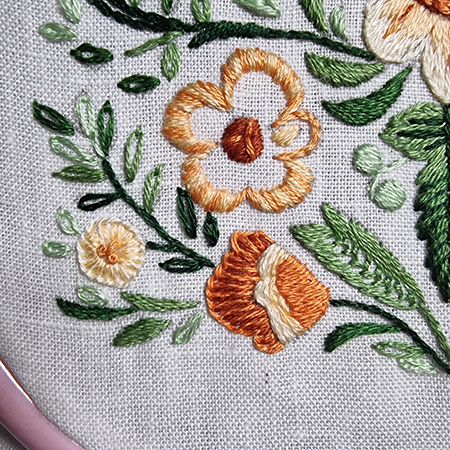
Embroider the small flower on the left with a blanket stitch in a round and add a few 2-thread 2-wrap French knots in the center of the design.
Tissue Box tile 4
Tissue Box Tile 4This week, we continue our adventure with the tissue box, embroidering his fourth and last side. Still inspired by Mexican tiles, these colorful and rhythmic patterns provide the perfect playground for experimenting with new colors and stitches. This...
Tissue Box tile 3
Tissue Box tile 3After bright yellow and brilliant blue, I'd like to introduce you to the third side of my tissue box today. I chose to embroider it in shades of old rose, a soft, elegant color that contrasts beautifully with the previous tones.Still inspired by...
Tissue Box, tile 2
Tissue Box tile 2Following on from the floral tissue box started last week, today I'd like to invite you to discover the second tile, again inspired by the magnificent Mexican tiles found in artisan markets. These little paintings, with their geometric or vegetal...
Tissue box
Tissue Box Tile 1 This new tissue box project combines the useful with the pleasurable: a simple object to integrate into the home, but worked in detail to make it a refined piece. I've designed four small, complementary motifs that will work equally well on this...
Thanks for the dimensions of the box
Love this idea
Keep on stitching