


A Garden for Pam & Lola
The Head
With this first step, we’re diving into the heart of the “Flowers for Pam and Lola” project.
This is where it all begins… and, above all, where everything comes down to.
The cat’s head isn’t just a technical detail, it already conveys the emotion of the piece. And even more than the shapes or patterns, it’s the eyes that will bring your embroidery to life, because a single glance can say it all.
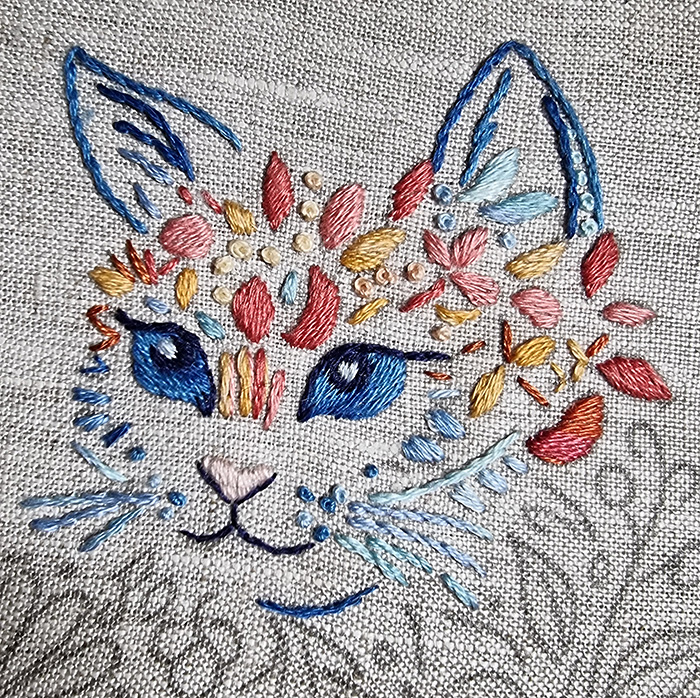
Before bringing the cat’s gaze to life, it is essential to lay down the first lines, the ones that give structure and establish the cat’s presence.
I naturally began this project with the ears, which are so important because they allow her to pick up on the slightest sound and communicate with those around her.
They are embroidered with two strands of thread, using a combination of stem stitch and French knots.
-
The stem stitch allows you to draw smooth lines
-
The French knots adds a subtle texture that evokes the softness of fur
For this section, I used the following colors:
DMC 824, 53c, 827 and 162
The creation of the eyes
I started by outlining the eye using a split backstitch with 1 thread in color 53C.
I then filled in the background of the eye, except for the pupil, using a satin stitch with a single strand of thread, in the same color,53C.
To add dimension, I applied a few small straight stitches of color 824 to the inner corner of the eye.
I then embroidered the pupil using the satin stitch, still with 1 strand of thread, using color 823.
The sparkle in the eyes is created using three or four tiny straight stitches, made with a single strand of thread in color 162, delicately placed in the center of the pupil.
Finally, I finished by outlining the upper part of the eye using a split backstitch with two threads of color 823, to accentuate the expression and evoke that slightly made-up look found in cats, almost like in ancient Egypt.
Tips for making a Great Look
Take your time embroidering the eyes with care and precision: this is a crucial step, the one where your work truly comes to life.
Work with a single thread and ensure your stitches are even. Pay close attention to the direction of your stitches: they should naturally follow the shape of the eye. It is this detail that prevents a stiff look and gives the eyes their softness. Light plays a fundamental role. Place your small, light-colored stitches carefully: too many will make the expression look harsh; too few will make it look lifeless. Finally, keep in mind that the eyes should not be perfect, but alive. It is often in small irregularities that the true presence of your embroidery comes to life.